Want to know what the masses aren’t doing? Read on.
It’s the time of year when wedding publications trawl search data, surveys and anecdotes to summarise the biggest trends in weddings this year and make their predictions for 2026 (here’s one from Hitched for example).
Bridgerton gowns, bubble hems, basque waists, second dresses and statement veils (duh) are on the rise, apparently. As interesting and insightful as all this is, as with all wedding traditions, my advice remains: adopt the ones that work for you and forget about the rest.
For anyone needing an antidote to reports on what everyone else is doing, here’s my own 2025 round-up of anti-trends: this is a report of what no-one else is doing, what people asked me to make for them because they couldn’t find it in the mainstream boutiques.
These are the wedding un-trends.
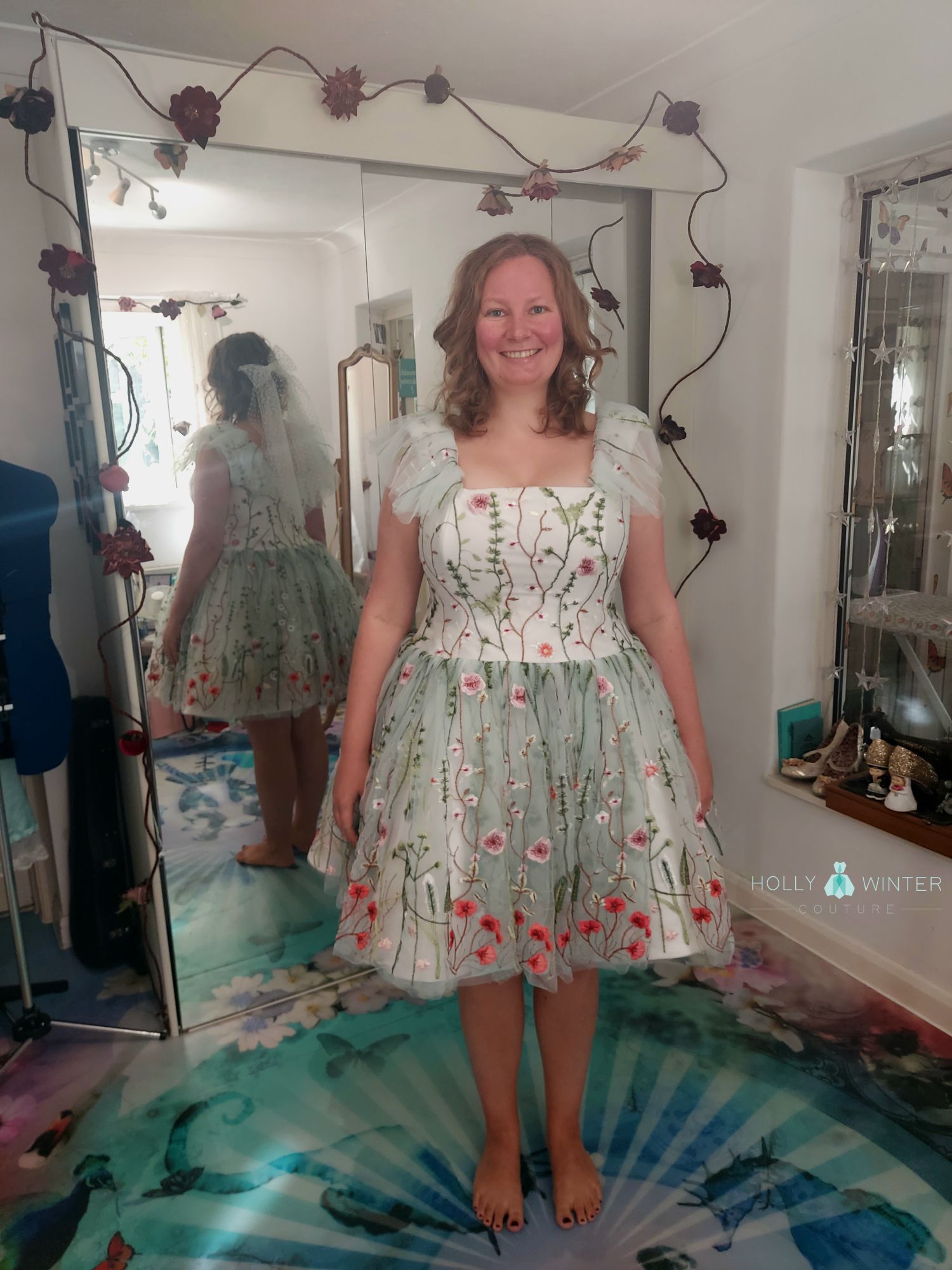
Ice-cream shades of pink and mint green, overlaid with bright floral embroidery……and some in-jokes, cute personal references and favourite characters.The bride’s late mum’s handwriting embroidered in blue on the ribbon wrapping her bouquetTribute tattoo embroidered on a veilTurn it greenTurn it pink, blush, peach and purpleAdd textureAdd volumeMake it the longest veil I’ve ever createdMake it change colour in daylightMake it CinderellaMake it Star Wars, Lord of the Rings and ZeldaMatching – but not too closely matching – jacket embroideryPumpkins and flowersPastel embroidery to repair the bride’s mother’s original veil
And there are more, but as the weddings have yet to take place, I can’t reveal all yet. But here’s a clue about one of them:
Considering a wedding dress with off-shoulder, Bardot straps? Read this first.
You know I’m not one for following trends for the sake of it, but an unavoidable one this summer is the Bardot neckline. Popularised by the eponymous actress Bridget Bardot in the 1950s and ’60s, the straight (or sweetheart) neckline elongated by off-shoulder straps has actually been around since Regency and Victorian eras.
It’s the straps we need to talk about. Loved for balancing out wide hips, narrowing broad shoulders, showing off the décolleté while remaining elegant and concealing bingo wings, they do have an inherent drawback.
The crux of Bardot straps is this: there will always be a trade-off between how well they fit and how much you can still move your arms.
Gorgeous Sarah opted to remove her Bardot straps (and train) completely, and straighten the neckline.
There are workarounds but all of them involve a compromise of some sort. If you want to be able to lift your arms at all on your wedding day – to hug guests, slow-dance with your new spouse, pick up children, toss your bouquet (or hold it victoriously aloft), throw shapes on the dancefloor, remove your veil or fix your hair – and have your heart set on this classic neckline, here’s what we can do.
Awesome Sophie in her Bardot-neckline wedding dress. Yes, she’s on the loo; yes, she’s allowed me to share this.
Option 1: Do nothing
Accept the fit of the straps as they are, which might be slightly baggy but almost certainly will limit how high you can lift your arms.
Option 2: Tighten them to fit
Some people are happy to sacrifice movement and just want them to sit as straight and snugly as possible. This is fine if it works for you, but your arms will be pinned to your sides and only usable from elbows down.
Option 3: Make them detachable
There are a few ways we can do this, including adding poppers so you can remove them entirely. Alternatively, we can have them fitting snugly but fashion a way for them to fold neatly under your arms if you choose to wriggle your arms out of them completely. Alternatively, you could wear a Bardot style as a bolero or even just a separate ‘collar’ that slips over your shoulders.
Option 4: Add elastic
A popular option with my customers this year has been to run some elastic through (or under) the straps so they fit more snugly but can still extend when arms are lifted. This option will cause some gathering/ruching in the straps, which some have embraced for its frilly effect and had me add elastic to the full strap, while others weren’t keen on the aesthetic and just had me add it towards the back.
Option 5: Engineer an internal runner
This is a clever option if you don’t mind the straps finishing tucked into the back (and/or front) of your dress rather than resting on top. Each strap is looped over a horizontal ‘bar’ of ribbon inside the dress that it can run along, while a length of elastic pulls it back into place when your arms are down. It doesn’t work with all dress and strap styles but worth asking about as it’s the best option for keeping a close fit while allowing maximum movement if it works.
Option 6: Raise where they sit
If you’re open to a neckline that isn’t quite strictly a Bardot, a final option is to raise where the straps sit, so they’re on the edge of your shoulder rather than around your arms. This means losing arm coverage (in case that’s a dealbreaker) and gaining coverage on your back so bear in mind whether you want that or not too.
Beautiful Debs, whose Bardot straps I raised to sit higher on her shoulders so her back would feel less exposed. Her sweetheart neckline lent itself particularly well to this alteration. Raising them also meant that, despite shortening them, she had more freedom of arm movement.
If you’ve yet to start wedding dress shopping, please don’t rule out a Bardot neckline, but remember that it will always require a compromise of some sort. And if you already have your Bardot-neckline dress, please don’t panic. Feel free to drop me a line and we can find the best solution for you and your dress.
Char in her gorgeous Bardot gown (with the five-metre custom veil I made her). Photo: Lauren Brumby Photography
“Can I ask if any brides are planning on changing into a 2nd veil for the evening? I’m not sure my cathedral veil will be practical for all day,” I read in a wedding group on social media this morning.
While some newlyweds stay in their wedding finery throughout the day and into the evening reception, it’s not uncommon to see a change in outfits. It might be the same outfit slightly modified – the train of the wedding dress gets bustled to make the back the same length as the front for dancefloor practicalities, a suit jacket or lace bolero discarded in the heat, detachable sleeves or overskirt whipped off for a transformation.
The transforming wedding dress I created for Gill, featuring a detachable cape veil and overskirt
Some people change their dress entirely. In Japan where I once spent a year, couples go through so many outfit changes on their wedding day – around five – that they start the morning with a feast because they won’t have time to eat again until the end of the night.
Other people change into a different dress or alternative outfit for the evening. It might be for practical reasons, or simply aesthetics.
Left: The dress I made for Rachael for her ceremony; R: Her sparkling evening reception dress
But what about the veil? In the last year, I’ve seen my first requests for veils specifically for the evening reception. Just like dresses, some are transforming and some are shorter versions of the ceremony veil.
Two transforming veils I’ve made for customers, that use a mechanism similar to dress bustles to make them shorter
I’ve also had orders for a shorter version of the ceremony veil so they can still wear a veil for evening without the worry of it being trampled once the dancefloor throng is in full swing. I’m currently making two versions of the same veil for a customer – one 144″ long for the ceremony and the other 30″ for the evening. I’ll share both as soon as I’m allowed.
“It’S nOt TrAdItOnAl!”
I’ve seen some backlash though, from cries of “I’ve seen it all now,” to seamstress refusals on principle to add a bustle to a veil. My favourite scoff as ever is, “It’s not traditional.”
So let’s not forget why we have wedding veils in the first place. In western culture at least, they were intended for the very practical purpose of concealing the bride from evil spirits lurking around churchyards hunting for virgins and, as we know, all brides are virgins. This was once a very real fear.
Over time, the superstition may have faded to near obscurity but the association of the veil with the wedding day has passed firmly into aesthetic tradition. Anyone not subscribing to the fears of old and/or chooses not to wear a blusher tier over their face is already wearing a veil for aesthetics only and not tradition in the strictest sense.
The only reason I didn’t keep my own veil on all day and night nearly 17 years ago was that it was my ‘something borrowed’ and I wanted to give it back before it fell in my dinner/down a toilet. I replaced it with a tulle wrap in the evening. It simply didn’t occur to me to wear a different veil that could take a little gravy (or worse).
So let’s agree that a veil is a headpiece like any other bow, hat, sparkly accessory or whatever. No-one would bat an eyelid at someone changing in or out of one between their own wedding ceremony and reception so I am absolutely here for the evening veil.
The Three Fs to consider to make sure your dream wedding dress doesn’t become a neurospicy nightmare
Shopping for – and wearing – a wedding dress is a whole new experience for most people. Seeing yourself as The Bride for the first time can be surreal and overwhelming, and you’re often in and out of several dresses in quick succession. Consequently, you might not have time or emotional energy to notice the little things that will make wearing one for a whole day uncomfortable.
Add the sensory issues that often come with neurodiversity into the mix and the dress of your dreams can end up feeling like a nightmare.
But not all dresses are created equal, and there are some common culprits to look out for when you’re choosing your dress, mainly around the three Fs: Fabrics, Finishes and Fit. Feel free to add your own F if you hit all three.
FABRICS
I’m not just talking about synthetic fabrics (polyester, nylon, etc) that make you sweat here, as you’ll be hard pressed to find a dress made from 100% breathable, natural fibres (e.g. silk, cotton, viscose, etc) in most boutiques. Sometimes you get a choice, especially if you’re going bespoke. Get samples you can take away and experiment with if you can.
Lace
Lace can be scratchy (particularly the stiffer kind in direct contact with your skin), or conversely tickly – I’m looking at you, eyelash lace necklines. Eyelash lace can usually be trimmed down to the solid edge if necessary so don’t let it put you off an otherwise perfect dress.
Tickle tickle! Beautiful and delicate, eyelash lace can also be a bit tickly for some people.
Check which parts of your body will be in contact and whether it will irritate you.
Feathers
Another tickly one is feathers. Even if you’re not outright allergic, feathers can tickle mot just your skin but the inside of your nose (they shed too). There can also be sharp bits.
Sequins
One of my biggest bugbears with wedding dress manufacturers is the placement of beads and – worse – sequins under the arms of sleeveless dresses where they will chafe the delicate skin of bare inner arms. Have you ever felt the edge of a sequin? Those buggers are SHARP. Now imagine rubbing your arm on clusters of them all day and night.
Even if they’re not right up in your armpit, check what your wrists will be brushing against if your dress has beads and sequins on the skirt. If they’re somewhere annoying, you can have them removed. Alternatively, if they’re too pretty to ditch, have your seamstress cover them in a soft sheer fabric such as tulle or organza so you can still have the sparkle without the scratching. If you’re open to a bit of a restyle, you could even add sleeves or gloves to protect your skin.
Glitter
A huge trend at the moment is glitter, especially on tulle, although I’ve also seen it on satin and even lace (and I’ve actually made two wedding dresses using a black glitter lace satin!). By its nature, it has a slightly rough texture so I usually recommend putting it under a layer of tulle rather than have it as the top layer of a dress. It will still sparkle but feel softer.
Veils are different as they’re not in constant contact with your skin.
FINISHES
It’s not just the fabrics themselves that can cause an issue, but what you do with them and where on the dress you wear them.
Stitched tulle
For example, even the softest tulle becomes a serious rash-inducing irritant when it’s folded and stitched, especially for a neckline; it makes every tiny fibre an inflexible ridge that RUBS. I see red skin under a lot of illusion panels where the edge has been turned under and sewn. It’s usually better to leave the edge raw and unstitched; I cut some away for a bride during her fitting this week and the relief was immediate.
Some tulle necklines and arm scyes (that’s the technical term for an armhole) have to keep their stitched edge to prevent them stretching out of shape during wear. In these cases, ask your seamstress to put something underneath the narrow hem to protect your skin. Depending on the dress, I’ve used iron-on soft interfacing (often seen on the back of embroidery on T-shirts for example) organza ribbon and clear silicon tape. Sometimes we need to experiment a bit to find what will work best for the dress and the wearer.
Unstitched tulle
It also depends on where on the dress they are. Unfinished stiff-tulle hems (usually in underskirts and inner dress layers) feel like barbed wire if they come into contact with the tops of your feet. When I get in a hot shower after a day when I’ve worked on stiff tulle, my hands and forearms suddenly sear from all the micro abrasions and scratches they’ve sustained from the edges.
Enclosing them in a rolled hem or encasing them in bias binding protects skin. I do this as standard on all my bespoke dresses, but not all manufacturers do (the last Vera Wang dress I altered didn’t; also polyester BTW), or they’re inconsistent with it (some Wed2b dresses have their stiff tulle hemmed, others don’t)
The raw edge of stiff tulle
Boning
Not quite a fabric, but an essential component of many wedding dresses is boning (stop sniggering at the back). It shouldn’t be uncomfortable but check where it finishes at the bottom to make sure it’s not digging in your tummy, hips or the tops of your legs, especially when you sit. I’ve had to shorten bodice bones for many people, especially wheelchair users.
Need a light boning, anyone? Fnarrrr
Smells
Smells might not be the first thing wedding dresses make you think of, but have a good sniff when you’re trying them on or choosing fabrics. Some manufacturers spray fabrics with chemicals that have a distinctive smell that not everyone can tolerate. Some have a sickly sweet smell and others more unpleasant odour of fish mixed PVA glue.
Cheap stiff tulle seems to be a repeat offender here. I once had to leave some outside (literally on the washing line) for two months before I could tolerate it inside, even after machine washing it twice. The smell still hadn’t completely gone so I gave up on it and invested in a better one, making a mental note never to cheap out on stiff tulle again.
If you’ve bought your dress second hand or a vintage number and specialist cleaning can’t get rid of smells, my friends in theatre always recommend spraying with cheap vodka.
FIT
Of course, making sure your dress fits well can solve a lot of sensory issues. But when you’re trying on samples that don’t fit you properly, make sure you understand what a proper fit will feel like.
Heavy + strapless = tight bodice
For heavy strapless dresses in particular, it might have to be tighter than you’d like. A weighty skirt section needs to rest snugly above your hips so it doesn’t fall down and have to doing the yank-it-up dance all day. By snug, I mean firm and supportive; you should still be able to breathe normally and feel like you could enjoy a full meal. Wedding dresses are not usually designed or worn for practicality but they shouldn’t be uncomfortable and should certainly never be painful.
If you’re someone who easily feels constricted in tighter clothes, consider whether a looser style might be for you. I’ve seen a dress trigger a panic attack once it fitted as it should because the bride didn’t realise that it would need to be so tight to stay up. She was autistic and had sensory issues against feeling squeezed. When she bought her heavy satin strapless ballgown, it was some inches too big for her – gaping all over and falling down – and she didn’t realise how much more snug the bodice would need to be to support the weight of the skirt. Even leaving it slightly looser than I would normally to accommodate her sensitivities (she explained them to me at our first appointment), it still felt too restrictive for her.
THE GOOD STUFF
I would love to be able to provide a definitive list of Fabrics, Finishes and Fits that won’t cause sensory issues. As we know though, if you know one neurospicy person you know one neurospicy person. Everyone’s needs, likes, dislikes and sensitivities are different, just as every dress will be different. Satin is lovely and smooth and could be a safe bet for many but it can be heavy and people like my daughter hate the sound and feel of someone running their nails on it. Most things are surmountable but might need more budget for alterations.
What I’m hoping to achieve here is to give some things to consider when choosing a wedding dress, whether that’s in a boutique, creating something bespoke or buying second hand.
Because I don’t ever again want to see someone’s face as they realise at their final fitting that they’ve made a mistake in their dress choice.
It’s the question in Facebook groups that makes me twitch: “What are you paying for your wedding dress alterations?”
It’s usually asked to get an idea of how much the poster should expect to pay for their own.
With no additional info it’s probably the mechanics’ equivalent of, “How much will it cost to get my car through its MoT?” I even asked a similar question of the RAC man this week as he poked under my car bonnet to ascertain why it had stopped dead on the school run, would no longer start and even the hazard lights had given up the ghost.
The alternator was kaput he informed me as he closed the bonnet with a tinny click. “Oh. How much is a new alternator then?” I asked, trying to sound like I might know what an alternator actually was.
Even knowing the make, model and pitiful state of my car (*cough* rollerskate *cough*), he could only guesstimate a range of £70-£400+ before checking online. There are apparently many options.
And so it is with wedding dress alterations. Wildly variable. Moreso than alternators even.
What your alterations will cost depends on a great many things, chief among them:
Your dress. Specifically, its design, construction, structure and embellishments etc. Taking up a dress with two plain layers is much easier, quicker and therefore cheaper than a dress with 11 layers including one with a lace hem that needs to be unpicked and stitched back on. Does it have beaded lace covering the bodice seams that needs to be removed and replaced to bring it in, sleeves that need shortening or is it strapless, etc?
What you need doing. Your dress might need letting out taking up, taking in, straps shortened, sleeves narrowed, back shortened, new cups, extra support, a bustle hook (or 12), extra embellishments, custom embroidery, a reshaped neckline, bespoke elements and any combination of these.
Where you live. There are differences between countries and within countries. A dressmakers’ Facebook group I’m in is currently conducting a UK-wide survey to get an idea of what we charge for common alterations by region but it’s proving tricky because of the wide variation of work.
Where your seamstress works. Do they have the overheads of a studio or are they home-based? If home-based, have they had to buy a much larger house beyond the required living area to accommodate a home studio? ‘Working from home’ as a seamstress requires a lot more space – several rooms in my case – than a corner with a laptop.
The seamstress’s relationship with where you bought your dress. Are they attached to the boutique and recommended exclusively (as most boutiques work) or one of many on a list (like Wed2b provides), or did you find them yourself? When I’ve worked as the exclusive seamstress for boutiques, they’ve taken between 10 and 25% of my alterations charge as a referral fee, which I had to add on to the customer. With the Wed2b list for example, I don’t have to pay to be on it and don’t get paid by Wed2b. You also won’t pay the fee if you find the seamstress independently.
The skill level, training and experience of the seamstress. A dressmaker friend Anita Dudley points out that just as you would expect to pay more for a senior stylist in a hair salon, a more experienced seamstress will likely cost more. When I was starting out, I offered enormous discounts to counter my lack of track record, even though the work took me at least twice as long as it does now.
The level of service that comes as standard. Some pros steam or fully press every dress they get or even offer a full cleaning service or storage facility. Others might charge differently for regular fittings vs family and friends dress reveals with champagne and canapés.
Another dressmaker friend Amanda Davies reminded me that one thing highly unlikely to have a bearing on alterations costs is what you paid for your wedding dress in the first place.
I’ve done alterations that cost the bride £50; I’ve also done alterations that cost nearly £1,000. I could work out the mean, median and mode of those and everything in between but still wouldn’t come up with anything informative until I had seen your dress in person and knew what you needed doing.
My dressmaker friend Kate Edmondson reminds me here that one thing highly unlikely to have a bearing on alterations costs is what you paid for your wedding dress in the first place. You might have got an absolute bargain online, in a sample sale, or even brand new but if it takes the same amount of skill and time to alter as a much pricier dress, the cost to alter them will be the same. Yes, that does mean that sometimes alterations cost more than the dress itself.
My advice to find out how much YOUR wedding dress will cost to alter is to get recommendations of seamstresses in your area and get some quotes. You can also use it as an opportunity to see how well you click with different people. After all, this is an intimate, high-stakes process so make sure the person you choose is someone who gets you.
A good starting place if you’re in the UK is the Find Your Bridal Seamstress Facebook Group, which is linked to the group for pros I’m part of that is running the regional cost surveys I mentioned.
Some extensive alterations included completely reshaping the back of this dress.
The car gets a new alternator tomorrow. It’s costing £250. 😏
‘Dress Regret’: the struggle is real – but IS surmountable
Between all the inquiries I get and social media bridal groups I’m in, something I see and hear almost daily is ‘dress regret’. You’ve bought/ordered your wedding dress and are now panicking you’ve made the wrong choice, should have tried more on, or worried about how you look in it.
You’re still bombarded with wedding day pics of couples looking awesome, not to mention designers’ perfectly styled publicity shots, and there will always be new collections, etc etc etc. You’ve had to choose one dress from almost infinite options so how can you ever feel you’ve got it right?
Out of the hundreds of customers I’ve worked with, I’ve only known two come for their fittings and then decide to buy a different dress, and both were already on their second or third dress at that point.
From experience, here’s a little reassurance about why dress regret creeps in and how we can thwart it:
Your dress doesn’t fit you – yet. All those wedding photos and publicity shots show well fitting dresses post-alterations (or clamped out of shot). Before alterations, it can just feel like you’re dressing up in someone else’s clothes. It gapes here, pinches there, is too long to fall properly, etc. Get to your seamstress and get it feeling like it’s actually YOUR dress.
You didn’t look for long enough. But tough shit, you can’t. You could buy the first dress you try on or you could try a different one on every day for years. It’s like studying for a test; when did you ever sit an exam and feel like you had revised ‘enough’?
You haven’t seen it in months. Many customers I see haven’t dared unpack their dress since the shop assistant expertly folded it between layers of tissue into its box. Some have stored it at someone else’s house so haven’t even been able to sneak a peek at it (especially true during lockdown). You might just need to refresh your memory of how gorgeous all the details are.
You’ve tried it on (or tried to) at home. Some dresses can’t be put on single-handedly, my own included. But I still tried, broke the hook and eye while trying to swivel it sideways and was then sufficiently paranoid I was going to burst through the seams Hulk-style on my wedding day that I (needlessly and knackeringly) crash dieted and even bought a back-up dress that never got worn. Don’t be me.
Being neurospicy. Indecision paralysis and the dopamine hit of buying something new are all the more challenging if you are autistic and/or have ADHD. Recognise if this is the case.
Others’ opinions – either too many or not enough. Take them on board but consider who they’re coming from and what their motives are. They’re not wearing it. They’re not you. Trust your own gut on what feels right for you.
Your body has changed since you bought it. Bodies are meant to change. You might have been ill, gained/lost weight, had a baby, gender reassignment, been breastfeeding, etc. It’s your seamstress’s job to make your dress fit your body, not yours to make your body fit your dress.
It’s a different time of your menstrual cycle. When I’m ovulating, I look (read: feel) like the sexiest person who ever lived. Two days before my period, I am (again, feel) hideous in everything (or, even worse, nothing).
The pressure to look ‘perfect’. Again, you can’t, because there’s no such thing. Even my husband and I affectionately describe each other as “almost perfect” because we recognise actual perfection doesn’t exist.
Want an objective opinion? I’m always happy to take a look at your dress either in person or pictures and give you options objectively (and kindly) so feel free to drop me a line.
It’s official: the “un-bride” is in. This is ironic as it essentially means that not following trends is the trend.
The stylist soothsayers are stirring their big-data cauldrons this week and forecasting the wedding trends for 2024. Amid the peach fuzz and torn up seating plans, I was pleasantly surprised that for the second year, the crux according to my bellwether Vogue is that formality and traditions will take a backseat to individual style.
So you can keep your big data, front-row seats at Wedding Fashion Week and your cauldrons (but I wouldn’t look a gift horse in the mouth) because I get to see what that actually means in practice. My customers tend to come to me when they have a good idea what they want but can’t find it in the shops – because it’s not something that would take off in the mainstream because not enough people would buy it.
And that’s the awesome thing.
So, based on what people have been asking me for over the last year, here’s what un-briding is looking like. The un-trends.
Transforming dress: see Gill’s detachable train and detachable cape. I’ve also been asked for a voluminous plain dress that unzips at the moment of the first dance
Not a dress. Jumpsuits, playsuits, trousers, separates, shirts with trains. Mixing up the traditionally masculine and feminine, like Skye’s Shakespearean Shirt of Dreams.
Lace that isn’t floral. Have embroidery software, will create lace. I’ve created bespoke lace and embroidery made of moons, text, pets, in-jokes, bats carrying antique micrometers and the handwriting of lost loved ones. I can even do photos if you fancy having your bodice made from other half’s embroidered face (or why stop there? Let’s make the skirt out of all the faces of your in-laws). The next dress I’m making has some of my most ambitious lace I’ve ever made and I am SO excited to show it (and slightly scared about potential legal action).
Colour. I made more black, blush (hello, peach fuzz!) red and blue veils last year than ivory while my bespoke ivory wedding dresses were level pegging with other colours.
Upcycling. I’ve just finished restyling a wedding dress as a cocktail dress (I’ll share pics as soon as it’s had it’s big reveal by the bride) and have incorporated lace from mothers’ and grandmothers’ wedding dresses and veils into others. Save the planet, share the love.
I’ve just come out of a wedding dress fitting with a bride who loved her dress bit now wants me to restyle the neckline of her dress because the priest (Catholic, if it’s relevant) conducting her church ceremony asked her:
Not my actual bride in question, just another badass.
“How revealing is your dress?”
Consequently, she has gone from loving her dress and feeling confident with the V-neck illusion panel (ie skin-toned translucent tulle) to being paranoid and wanting to add approx 4″ of lace to conceal her cleavage.
I’m not religious so wanted to get perspective(s) on whether I’m right to be feeling angry on her behalf. I feel the priest is policing her body, was sexist to ask her this (he didn’t ask the groom) and what she chooses to show of her own body at her own wedding is no concern of anyone else.
If it even makes a modicum of difference to the priest, should he even be a bloody priest? If he’s worried about what other people think, that’s irrelevant. If he’s worried about being distracted himself, or having “impure” thoughts provoked, that’s a him problem, not a neckline issue.
If he’s concerned about some epidermis causing a distraction, I’ve offered to dance at the back in a bikini.
I realise this is technically none of my business either but I’m feeling invested now after seeing the effect his probing has had on the bride.