Want to know what the masses aren’t doing? Read on.
It’s the time of year when wedding publications trawl search data, surveys and anecdotes to summarise the biggest trends in weddings this year and make their predictions for 2026 (here’s one from Hitched for example).
Bridgerton gowns, bubble hems, basque waists, second dresses and statement veils (duh) are on the rise, apparently. As interesting and insightful as all this is, as with all wedding traditions, my advice remains: adopt the ones that work for you and forget about the rest.
For anyone needing an antidote to reports on what everyone else is doing, here’s my own 2025 round-up of anti-trends: this is a report of what no-one else is doing, what people asked me to make for them because they couldn’t find it in the mainstream boutiques.
These are the wedding un-trends.
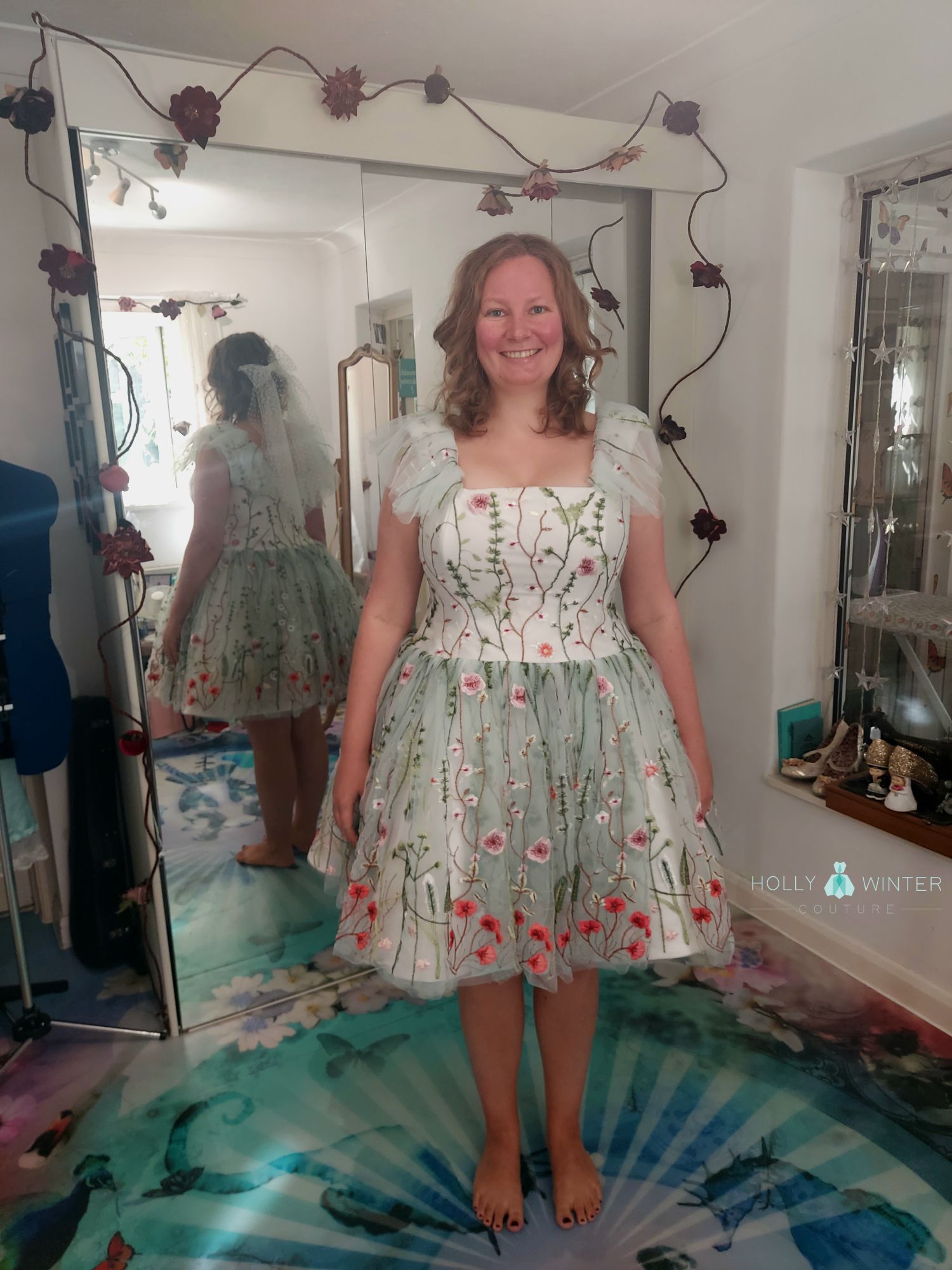
Ice-cream shades of pink and mint green, overlaid with bright floral embroidery……and some in-jokes, cute personal references and favourite characters.The bride’s late mum’s handwriting embroidered in blue on the ribbon wrapping her bouquetTribute tattoo embroidered on a veilTurn it greenTurn it pink, blush, peach and purpleAdd textureAdd volumeMake it the longest veil I’ve ever createdMake it change colour in daylightMake it CinderellaMake it Star Wars, Lord of the Rings and ZeldaMatching – but not too closely matching – jacket embroideryPumpkins and flowersPastel embroidery to repair the bride’s mother’s original veil
And there are more, but as the weddings have yet to take place, I can’t reveal all yet. But here’s a clue about one of them:
What I’m really thinking when I say brides,bridalwear etc
My blog post that’s currently blowing up (for me; everything’s relative) about making wedding dresses for people of all genders and sexes included this side note about the term ‘bridalwear’:
I use the term bridalwear as loosely as possible because not all of my customers identify as brides. I try to use more inclusive terms where I can. I specialise in dresses and the traditionally more feminine styles of weddingwear such as dresses, veils, jumpsuits and separates rather than men’s suiting and tailoring and I’m still answerable to the SEO gods – I need people to find me! As language, attitudes and social mores evolve, this will change of course. In the meantime, I’m always happy to learn and stand corrected if I’m saying or doing something deplorable.
I want to elaborate. I almost always do.
It’s a topic very close to my heart, my family and my English Language degree.
I can’t do away with the term. At least not yet.
Many of my customers not only identify as a bride but embrace the (hopefully) once in a lifetime opportunity to be The Bride. I don’t want to deny them that.
When I know someone is happy to be called a bride, I will use the term for that individual in my conversations with them and in describing them publicly.
Others don’t. I equally don’t want to force an erroneous identity on them or make them feel excluded or othered. I always endeavour to check. Some prefer marrier, partner, or something else.
When I’m talking generally about unknown individuals, I use inclusive, gender-neutral language such as couples, spouse, nearly-weds or customers.
I completed an LBGTQ Awareness Course four years ago with the sadly now defunct Wedding Business School a few years back.
I’d hoped to revisit it for this post but will have to rely on my memory. Quite rightly, it advocated gender-neutral terms.
But I’m finding it tricky to describe what I do, and who I do it for, without saying bridal or bridalwear.
I could – and do – say I make wedding dresses, but I don’t just make those; I make veils, jumpsuits, playsuits and separates including trousers, skirts, capes and overskirts too. My very first foray into creating wedding outfits was inspired by the bow-ties and masculine tailoring of Marlene Dietrich in the film Morocco.
Credits below*
And I love throwing androgynous flamboyance into the mix, like I did when I created the Skye shirt-cape:
But if I say I make wedding outfits or weddingwear, that feels like it covers more than I actually do, because I don’t make traditional menswear like tailcoats, shirts, waistcoats and morning suits.
So I don’t want to waste anyone’s time by contacting me about making them something I don’t make.
And I do want to stay visible in search results when people look for “bridalwear near me”. Don’t even get me started on hashtags. I have to use the hashtags that people looking for the kind of things I make use so they can find me.
How about emojis? Decorative, convenient shorthand, especially where there are character limits. When there are gender neutral options, I use those. If I can use female, male and non-binary together, so much the better.
My Instagram highlight of real customers
For example, on my Instagram, I have a highlight featuring my customers in my creations on their wedding days. Originally I called it Real Brides, which was the maximum character limit that would stay visible on my profile. When I realised this was not only not inclusive but also inaccurate, I changed it to Real Customers, but only Real Custom remained visible and just looked odd. Similarly, Real Weddings became Real Weddin.
Emojis to the rescue. Then I had to pick which skin colours to include (and exclude). ARGH!
Ultimately, I have carved a career out of celebrating individuality. That’s what bespoke is.
So whoever you are and however you identify, please know that I see you, I love you and I’m just waiting for the language and SEO gods to catch up.
*Venue: @weddings_the_boat_shed_salt Photography: @photosbypaloma Bridalwear: me! @hollywintercouture Model: @gabbywaite97 Flowers: @lilybee822 Jeweller: @bishboshbecca Headpieces: @peacock_and_pearl Shoes: @irregularchoice Hair and make-up: @tonisearlemua Cakes: @annalewiscakes Mobile bar: @effervescerefreshments
My last blog post, confirming that I make wedding dresses etc for people of all sexes and genders, received a surprising amount of love for what I felt was simply a statement of the bleeding obvious.
So I hope I don’t lose any of that love by clarifying a couple of points. The first is about consent. When I said:
If there’s consent in your relationship, there’s no judgment, kink-shaming or awkward questions here.
I didn’t just mean consent in your relationship(s); I also meant with me.
I’ve had requests to make wedding dresses for individuals for whom wearing one is – their words – a sexual fantasy or fetish.
This isn’t an issue. Like I said, no judgment or kink-shaming here. UNLESS – and it is a big UNLESS – UNLESS you expect me to play an active role in the actual sexual experience.
There is a big difference between having me create a wedding dress with which you do what you want afterwards, and the fetishised experience of being measured, fitted and dressed in your gown – by me – for sexual gratification.
I understand that I am sexually irresistable but sorry, I’m not down with that.
Someone once called me to ask if I could provide a three-hour bridal dressing up experience – hair, make-up and all – to fulfil a sexual fantasy. I can’t whip up a wedding dress in that time (he thought I kept ready-made stock), and I don’t think he realised my studio is home-based.
Consequently, I didn’t get as far as asking what he expected me to actually be doing during this time, whether I would be there too or be sitting with my children in the next room until it was time to start the clean-up.
There are companies that provide such fantasy dress-up experiences, and I found one to recommend to him. If you’re interested, it was in Brighton but it was pre-Covid and I forget the name. You can Google it. Maybe don’t use your work laptop.
Anyway, I appreciate he actually asked me, i.e. sought my consent.
Unlike the next chap.
I can’t get into the psychology of flashers but this one felt one step away as he forced details of his fantasy on me (and several of my dressmaker friends is turned out), heavy breathing and sneering down the withheld number.
It started routinely enough: could I make two matching dresses. Of course.
One for his mum. Absolutely.
The other for him. No problem.
Because he enjoyed dressing up with her in her underwear and… I missed whatever the next bit was in all the heavy breathing and the sneering.
I think – I hope – I disappointed him by not being outwardly shocked. Instead I told I’d be very happy to, thanked him for being brave enough to share such personal details and that I’d be happy to send him payment details for the booking fee. But I’m still angry that he forced a sexual experience (for himself) on me without my consent, and did so again with others.
Anyway, I digress as I doubt this was actually a genuine inquiry. So, on to those.
Perhaps we should be rivals, but we don’t see it that way. There’s plenty of work to go around and we need to know who we can recommend when we’re fully booked. And you can’t work in weddings and not have at least one back-up plan if something takes you out of action in peak season; last year for example, just as I recovered from Covid, I broke my arm. The year before, I’d picked up brides when a dressmaker friend broke her leg.
We have Facebook groups, WhatsApp groups and Christmas parties. We celebrate each other’s new shop openings, dress designs, birthdays and business anniversaries.
More tellingly, we are open and vulnerable with each other. We ask for advice and help. We admit when we don’t know the technique for something or have never used a particular machine or stitch.
Even better, within minutes usually, someone provides the answer and willingly, voluntarily, steps in to teach what we need to know.
Last month, I wanted to know how to do a delicate edging stitch I’d seen at the V&A’s Chanel exhibition. Unfortunately in that case, it turned out I would need two new machines: a picot hemming machine and a time machine, because picot hemming machines haven’t been manufactured for a century, BUT it was dressmakers in my network who told me this.
Anyway. I’m going to go against the sisterhood grain here and call someone out, albeit not by name.
I’d made a veil a bride not local to me who was having her dress altered by someone else. I’d made her friend’s wedding dress a few years back and included a bustle hook as standard, and she asked her seamstress to add one to her dress. She even described quite specifically the type she wanted (there are several).
When she went to pick her dress up, there was no bustle hook. Instead, the seamstress handed her these three safety pins.
This is not a bustle hook. “Just use these,” my bride was told.
There are bustle pins you can buy, but I’ve never recommended them. Figuring out which bits of many layers to attach them to, usually at the point of the wedding when most people have had a few sherberts, is not simple. Worse, they make holes in the fabric, and my bride asked whether this would happen.
“Yes,” was the response, “but hopefully no-one will see them.”
Pick. My. Jaw. Off. The. Floor.
I want to give the seamstress the benefit of the doubt. We all have off days. Maybe she forgot. Maybe she was rushed. Maybe she didn’t actually know how to bustle this dress but she’a a professional seamstress workong with a bridal boutique. Maybe there was a reason she couldn’t do it that hasn’t occurred to me, because I can’t fathom why she recommended this.
I’m not local or available in time so couldn’t do it myself but, predictably, someone from my needle ninja network stepped in within hours to add the bustle hook (thank you again, Tina).
A member of our Facebook group said of she found out the safety pin seamstress was a member, she’d be kicked out.
Another customer, a tattoo artist, was in awe when I told her about how supportive dressmakers are, and was rightly envious. She told me that her industry was rife with rivalry and bitchiness.
We are so passionate about what we do and seeing it done well. Keep your safety pins for emergencies, not your bustles.
A marriage based on a lie is not likely to end well, so it’s startling to see a purported wedding expert recommending starting a relationship with a lie. OK, not quite a relationship with someone you’re marrying, but Bridebook has just been caught advising couples to approach wedding suppliers by saying they’re having a party, not a wedding.
Screenshot of Bridebook’s advice to engaged couples
Lie to your suppliers? Where’s that going to get you? There’s a reason wedding-related services often cost more: they ARE more. You GET more.
What’s especially galling for vendors – on whom Bridebook relies to fill its own coffers – is that it’s annual wedding report published in the last few weeks extolls the importance of trust, connection and price transparency.
Bridebook’s ‘This you?’ moment
In my case as a bridalwear designer and dressmaker, the very fact that that is all I do tells you everything you need to know about how specialised it is. So actually, if you come to me for asking for a party dress, I’m not your woman and the answer will be no. Tell me then it’s actually a wedding dress you want and you just didn’t trust me to price it fairly, and how keen do you expect me to be to work with you?
Bridebook also seems to forget that vendors have often planned their own weddings at some point too. I swore when I started my business that I would never charge extra for my services just because the dress was white. But I will charge accordingly for additional structure, delicate fabrics, intricate embroidery and beaded details, all the additional layers and the complexity of the design. Because all that is more work and takes more time. Beautiful, enjoyable time in which I’m in my element but I can’t do it for nothing.
Keep asking my husband though, because his business is going well and apparently this time next year, we’ll be millionaires.
This time next year, Rodney
Although he has been saying that for nearly four years now. Oh shit, was that a lie?
Specialthanks to Plaits & Pin Curls, Bex Brides, Magpie Wedding and Rock n Roll Bride for bringing this to my attention and for all you do to actually support our wedding world.
Update: Bridebook has apparently now removed the article from its website.
It’s official: the “un-bride” is in. This is ironic as it essentially means that not following trends is the trend.
The stylist soothsayers are stirring their big-data cauldrons this week and forecasting the wedding trends for 2024. Amid the peach fuzz and torn up seating plans, I was pleasantly surprised that for the second year, the crux according to my bellwether Vogue is that formality and traditions will take a backseat to individual style.
So you can keep your big data, front-row seats at Wedding Fashion Week and your cauldrons (but I wouldn’t look a gift horse in the mouth) because I get to see what that actually means in practice. My customers tend to come to me when they have a good idea what they want but can’t find it in the shops – because it’s not something that would take off in the mainstream because not enough people would buy it.
And that’s the awesome thing.
So, based on what people have been asking me for over the last year, here’s what un-briding is looking like. The un-trends.
Transforming dress: see Gill’s detachable train and detachable cape. I’ve also been asked for a voluminous plain dress that unzips at the moment of the first dance
Not a dress. Jumpsuits, playsuits, trousers, separates, shirts with trains. Mixing up the traditionally masculine and feminine, like Skye’s Shakespearean Shirt of Dreams.
Lace that isn’t floral. Have embroidery software, will create lace. I’ve created bespoke lace and embroidery made of moons, text, pets, in-jokes, bats carrying antique micrometers and the handwriting of lost loved ones. I can even do photos if you fancy having your bodice made from other half’s embroidered face (or why stop there? Let’s make the skirt out of all the faces of your in-laws). The next dress I’m making has some of my most ambitious lace I’ve ever made and I am SO excited to show it (and slightly scared about potential legal action).
Colour. I made more black, blush (hello, peach fuzz!) red and blue veils last year than ivory while my bespoke ivory wedding dresses were level pegging with other colours.
Upcycling. I’ve just finished restyling a wedding dress as a cocktail dress (I’ll share pics as soon as it’s had it’s big reveal by the bride) and have incorporated lace from mothers’ and grandmothers’ wedding dresses and veils into others. Save the planet, share the love.
Me: Always choose a couture bridal specialist to work on your wedding dress. The skills they have over your aunt’s friend or your own DIY efforts if you’re not a pro are worth every penny.
Also me: I’m not spending £8 – eight whole pounds – on that Hobbycraft kit when I can make one myself for my children’s birthdays.
I broke my wrist last Thursday. My right, and I’m right handed, at the start of what are typically my two busiest months of the year.
Sad, tired face; lumpy bent wrist
I was booked solid with alterations, bespoke creations and embroidered veil orders and one split-second stumble backwards rendered me on my arse in every sense. I have a Colles distal radial fracture, more technically known as A Proper Number.
By Friday lunchtime, I’d found that I could accomplish many routine tasks with my left hand, even if brushing my teeth was more like punching myself in the face. Crucially I could still sew, with the exception of some techniques, BUT I couldn’t cut fabric.
The largest scissors I could wield were my tiny stork-shaped embroidery scissors which barely nibble fabric, and I couldn’t exert enough pressure on my rotary cutter to get the blade through even the lightest tulle.
So, painstakingly (and painfully), I typed out a message with one thumb, dropping my phone on my foot a couple of times, to the A-Level student I’d told the previous week that I couldn’t take him in for work experience.
Krishal the wunderkind
Krishal came over almost immediately and I liked him even more quickly than that. Actually, everything was speedy. He’d said he was a fast learner and I threw him in at the deep end with techniques he’d never used; he swam with them all. Rotary cutter, narrow-hem machine foot, seam ripper: all nailed first time.
Get this: he’d never used a seam ripper (aka stitch unpicker, the Ctrl+Z of sewing) because he’d never needed to. He’d never sewn a thing wrong. Ever. Including on his first A-Level project, an ambitious cocktail mini-dress with crinoline underskirt in fabric he dyed himself.
Not only that, but he’s taught himself French and Japanese, because he wants to work in Paris and Tokyo. And he’s a gifted musician. And tennis player. And 5,000m runner. Oh, and he’s been approached by a modelling agency.
We’ve been geeking out about sewing AND linguistics AND Disney films (these are a few of my favourite things 🎶) and I think I want to adopt him.
True, I do ❤️ yoga.
A week on, I’m sustaining fewer facial injuries while cleaning my teeth and I can now cut fabric again. Far from simply shadowing and observing me on work experience and making cups of tea, Krishal has been doing skilled work for which I have paid him the rate I would receive for the same jobs.
He is clearly someone who will go far. If his mum and dad refuse to surrender their parental rights to me, I at least hope that one day, while jetting between his Paris and Tokyo ateliers, Krishal remembers me and that he was once – literally – my right hand man.
“We recently attended a wedding and the bride wore THE DRESS I brought to you a few months ago. I could have screamed!!”
So began an email from one of my brides whose dress I’m altering later this year. Imagine. You’ve just spent more money than you’ve ever spent on one item of clothing that you’ll probably only wear once, on arguably the most significant day in your life with all eyes on you… and someone has beaten you to it.
I imagine the feeling must be similar to that felt by Captain Scott’s Antarctic party when it finally ended the near 900 mile expedition at the South Pole over a year after setting out, only to find a note from their rival Norwegians informing them they’d beaten them to it by 35 days. But without the prospect of imminent death from hypothermic exposure.
You get me. Edward Adrian Wilson, Robert Falcon Scott, Lawrence Oates, Henry Robertson Bowers (photo credit) and Edgar Evans at the South Pole.
Shop closures reduce choice
The closure of many traditional bridal boutiques – all but one within three miles of me in the last few years – is limiting choice for brides so the chances of buying the same dress as a friend or relative has increased.
Brides usually come to me for bespoke dresses because they have a good idea of what they want but it doesn’t exist in boutiques. A secondary reason is that they want the peace of mind that no-one could possibly have the same dress (or whatever) as them. But I digress.
This bride is actually the third customer I’ve had in this predicament, although hers was all the more galling because the dress in question was already the third one she’d bought and had to return. The silver lining is that she now has a new dress, completely different, but absolutely stunning, and we’re working on incorporating some of the meaningful details she loved.
Each of my other brides handled the predicament differently. The first asked me to completely restyle the back of her dress, removing most of it and dropping the flare point of her fit-and-flare skirt section (below). That made it sufficiently different from the bride with the same dress, plus there wasn’t a lot of crossover of guests attending each wedding.
The other bride’s dress doppelganger was closer to home: her new sister-in-law. This meant that a lot of guests – my customer’s entire family – would attend both weddings.
However, she decided to wear her dress anyway. You know how people complain that wedding dresses look completely different on the model? My bride reasoned that their different body types, flowers and accessories would make enough of a change that not many people would notice, and she didn’t mind too much if they did.