Want to know what the masses aren’t doing? Read on.
It’s the time of year when wedding publications trawl search data, surveys and anecdotes to summarise the biggest trends in weddings this year and make their predictions for 2026 (here’s one from Hitched for example).
Bridgerton gowns, bubble hems, basque waists, second dresses and statement veils (duh) are on the rise, apparently. As interesting and insightful as all this is, as with all wedding traditions, my advice remains: adopt the ones that work for you and forget about the rest.
For anyone needing an antidote to reports on what everyone else is doing, here’s my own 2025 round-up of anti-trends: this is a report of what no-one else is doing, what people asked me to make for them because they couldn’t find it in the mainstream boutiques.
These are the wedding un-trends.
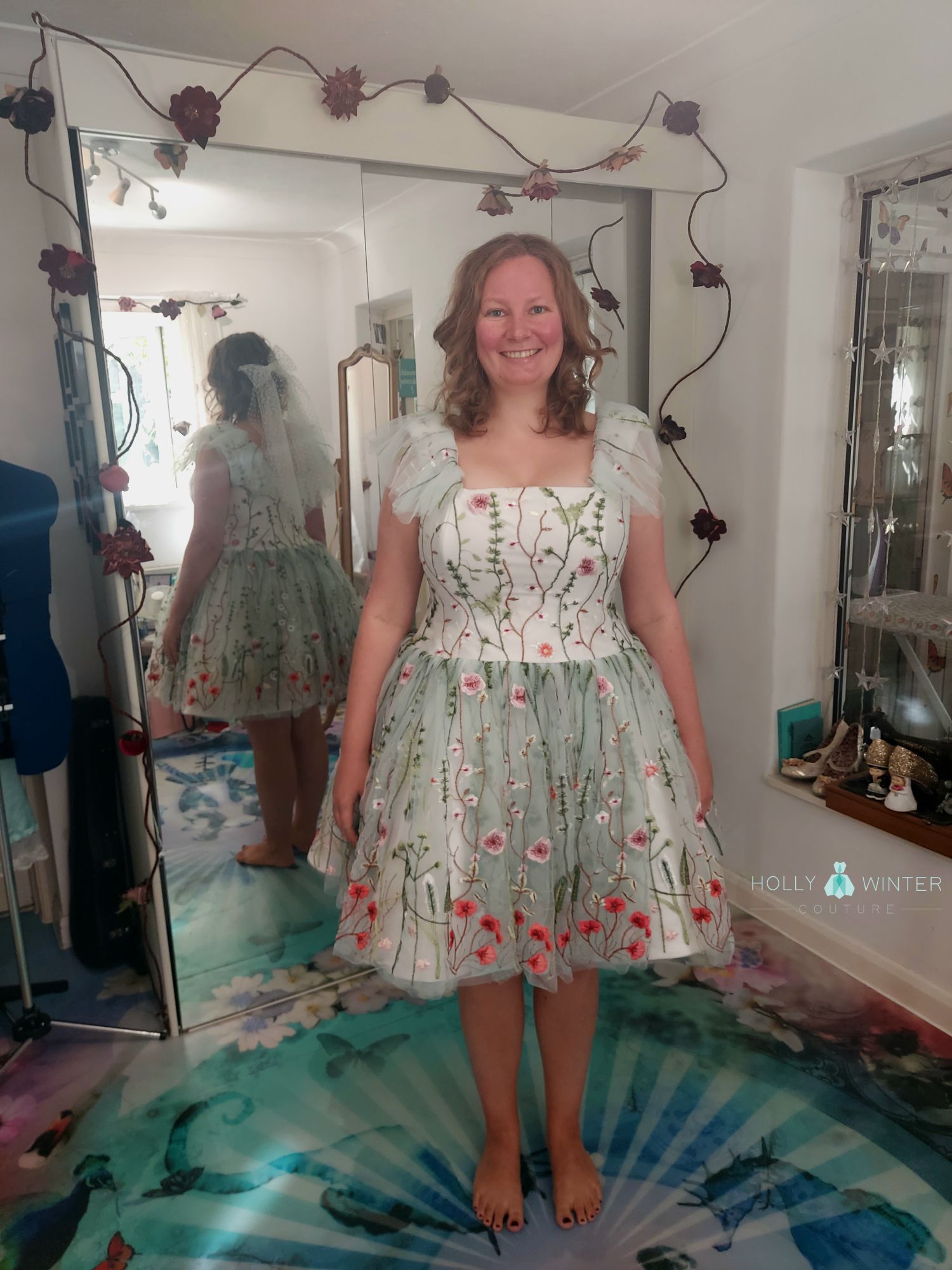
Ice-cream shades of pink and mint green, overlaid with bright floral embroidery……and some in-jokes, cute personal references and favourite characters.The bride’s late mum’s handwriting embroidered in blue on the ribbon wrapping her bouquetTribute tattoo embroidered on a veilTurn it greenTurn it pink, blush, peach and purpleAdd textureAdd volumeMake it the longest veil I’ve ever createdMake it change colour in daylightMake it CinderellaMake it Star Wars, Lord of the Rings and ZeldaMatching – but not too closely matching – jacket embroideryPumpkins and flowersPastel embroidery to repair the bride’s mother’s original veil
And there are more, but as the weddings have yet to take place, I can’t reveal all yet. But here’s a clue about one of them:
Considering a wedding dress with off-shoulder, Bardot straps? Read this first.
You know I’m not one for following trends for the sake of it, but an unavoidable one this summer is the Bardot neckline. Popularised by the eponymous actress Bridget Bardot in the 1950s and ’60s, the straight (or sweetheart) neckline elongated by off-shoulder straps has actually been around since Regency and Victorian eras.
It’s the straps we need to talk about. Loved for balancing out wide hips, narrowing broad shoulders, showing off the décolleté while remaining elegant and concealing bingo wings, they do have an inherent drawback.
The crux of Bardot straps is this: there will always be a trade-off between how well they fit and how much you can still move your arms.
Gorgeous Sarah opted to remove her Bardot straps (and train) completely, and straighten the neckline.
There are workarounds but all of them involve a compromise of some sort. If you want to be able to lift your arms at all on your wedding day – to hug guests, slow-dance with your new spouse, pick up children, toss your bouquet (or hold it victoriously aloft), throw shapes on the dancefloor, remove your veil or fix your hair – and have your heart set on this classic neckline, here’s what we can do.
Awesome Sophie in her Bardot-neckline wedding dress. Yes, she’s on the loo; yes, she’s allowed me to share this.
Option 1: Do nothing
Accept the fit of the straps as they are, which might be slightly baggy but almost certainly will limit how high you can lift your arms.
Option 2: Tighten them to fit
Some people are happy to sacrifice movement and just want them to sit as straight and snugly as possible. This is fine if it works for you, but your arms will be pinned to your sides and only usable from elbows down.
Option 3: Make them detachable
There are a few ways we can do this, including adding poppers so you can remove them entirely. Big consideration here: you will have to remember how much you can (or can’t) raise your arms, because they WILL pop off if you accidentally move too much. We can add hooks and eyes to for more security but if they’re attached to delicate fabrics, there’s a risk they could tear.
One non-popper (or other fastening) option is to have them fitting snugly but fashion a way for them to fold neatly under your arms if you choose to wriggle your arms out of them completely. Alternatively, you could wear a Bardot style as a bolero or even just a separate ‘collar’ that slips over your shoulders.
Option 4: Add elastic
A popular option with my customers this year has been to run some elastic through (or under) the straps so they fit more snugly but can still extend when arms are lifted. This option will cause some gathering/ruching in the straps, which some have embraced for its frilly effect and had me add elastic to the full strap, while others weren’t keen on the aesthetic and just had me add it towards the back.
Option 5: Engineer an internal runner
This is a clever option if you don’t mind the straps finishing tucked into the back (and/or front) of your dress rather than resting on top. Each strap is looped over a horizontal ‘bar’ of ribbon inside the dress that it can run along, while a length of elastic pulls it back into place when your arms are down. It doesn’t work with all dresses and strap styles but worth asking about as it’s the best option for keeping a close fit while allowing maximum movement if it works.
Option 6: Raise where they sit
If you’re open to a neckline that isn’t quite strictly a Bardot, a final option is to raise where the straps sit, so they’re on the edge of your shoulder rather than around your arms. This means losing arm coverage (in case that’s a dealbreaker) and gaining coverage on your back so bear in mind whether you want that or not too.
Beautiful Debs, whose Bardot straps I raised to sit higher on her shoulders so her back would feel less exposed. Her sweetheart neckline lent itself particularly well to this alteration. Raising them also meant that, despite shortening them, she had more freedom of arm movement.
If you’ve yet to start wedding dress shopping, please don’t rule out a Bardot neckline, but remember that it will always require a compromise of some sort. And if you already have your Bardot-neckline dress, please don’t panic. Feel free to drop me a line and we can find the best solution for you and your dress.
Char in her gorgeous Bardot gown (with the five-metre custom veil I made her). Photo: Lauren Brumby Photography
“Can I ask if any brides are planning on changing into a 2nd veil for the evening? I’m not sure my cathedral veil will be practical for all day,” I read in a wedding group on social media this morning.
While some newlyweds stay in their wedding finery throughout the day and into the evening reception, it’s not uncommon to see a change in outfits. It might be the same outfit slightly modified – the train of the wedding dress gets bustled to make the back the same length as the front for dancefloor practicalities, a suit jacket or lace bolero discarded in the heat, detachable sleeves or overskirt whipped off for a transformation.
The transforming wedding dress I created for Gill, featuring a detachable cape veil and overskirt
Some people change their dress entirely. In Japan where I once spent a year, couples go through so many outfit changes on their wedding day – around five – that they start the morning with a feast because they won’t have time to eat again until the end of the night.
Other people change into a different dress or alternative outfit for the evening. It might be for practical reasons, or simply aesthetics.
Left: The dress I made for Rachael for her ceremony; R: Her sparkling evening reception dress
But what about the veil? In the last year, I’ve seen my first requests for veils specifically for the evening reception. Just like dresses, some are transforming and some are shorter versions of the ceremony veil.
Two transforming veils I’ve made for customers, that use a mechanism similar to dress bustles to make them shorter
I’ve also had orders for a shorter version of the ceremony veil so they can still wear a veil for evening without the worry of it being trampled once the dancefloor throng is in full swing. I’m currently making two versions of the same veil for a customer – one 144″ long for the ceremony and the other 30″ for the evening. I’ll share both as soon as I’m allowed.
“It’S nOt TrAdItOnAl!”
I’ve seen some backlash though, from cries of “I’ve seen it all now,” to seamstress refusals on principle to add a bustle to a veil. My favourite scoff as ever is, “It’s not traditional.”
So let’s not forget why we have wedding veils in the first place. In western culture at least, they were intended for the very practical purpose of concealing the bride from evil spirits lurking around churchyards hunting for virgins and, as we know, all brides are virgins. This was once a very real fear.
Over time, the superstition may have faded to near obscurity but the association of the veil with the wedding day has passed firmly into aesthetic tradition. Anyone not subscribing to the fears of old and/or chooses not to wear a blusher tier over their face is already wearing a veil for aesthetics only and not tradition in the strictest sense.
The only reason I didn’t keep my own veil on all day and night nearly 17 years ago was that it was my ‘something borrowed’ and I wanted to give it back before it fell in my dinner/down a toilet. I replaced it with a tulle wrap in the evening. It simply didn’t occur to me to wear a different veil that could take a little gravy (or worse).
So let’s agree that a veil is a headpiece like any other bow, hat, sparkly accessory or whatever. No-one would bat an eyelid at someone changing in or out of one between their own wedding ceremony and reception so I am absolutely here for the evening veil.
It’s official: the “un-bride” is in. This is ironic as it essentially means that not following trends is the trend.
The stylist soothsayers are stirring their big-data cauldrons this week and forecasting the wedding trends for 2024. Amid the peach fuzz and torn up seating plans, I was pleasantly surprised that for the second year, the crux according to my bellwether Vogue is that formality and traditions will take a backseat to individual style.
So you can keep your big data, front-row seats at Wedding Fashion Week and your cauldrons (but I wouldn’t look a gift horse in the mouth) because I get to see what that actually means in practice. My customers tend to come to me when they have a good idea what they want but can’t find it in the shops – because it’s not something that would take off in the mainstream because not enough people would buy it.
And that’s the awesome thing.
So, based on what people have been asking me for over the last year, here’s what un-briding is looking like. The un-trends.
Transforming dress: see Gill’s detachable train and detachable cape. I’ve also been asked for a voluminous plain dress that unzips at the moment of the first dance
Not a dress. Jumpsuits, playsuits, trousers, separates, shirts with trains. Mixing up the traditionally masculine and feminine, like Skye’s Shakespearean Shirt of Dreams.
Lace that isn’t floral. Have embroidery software, will create lace. I’ve created bespoke lace and embroidery made of moons, text, pets, in-jokes, bats carrying antique micrometers and the handwriting of lost loved ones. I can even do photos if you fancy having your bodice made from other half’s embroidered face (or why stop there? Let’s make the skirt out of all the faces of your in-laws). The next dress I’m making has some of my most ambitious lace I’ve ever made and I am SO excited to show it (and slightly scared about potential legal action).
Colour. I made more black, blush (hello, peach fuzz!) red and blue veils last year than ivory while my bespoke ivory wedding dresses were level pegging with other colours.
Upcycling. I’ve just finished restyling a wedding dress as a cocktail dress (I’ll share pics as soon as it’s had it’s big reveal by the bride) and have incorporated lace from mothers’ and grandmothers’ wedding dresses and veils into others. Save the planet, share the love.
I’ve just come out of a wedding dress fitting with a bride who loved her dress bit now wants me to restyle the neckline of her dress because the priest (Catholic, if it’s relevant) conducting her church ceremony asked her:
Not my actual bride in question, just another badass.
“How revealing is your dress?”
Consequently, she has gone from loving her dress and feeling confident with the V-neck illusion panel (ie skin-toned translucent tulle) to being paranoid and wanting to add approx 4″ of lace to conceal her cleavage.
I’m not religious so wanted to get perspective(s) on whether I’m right to be feeling angry on her behalf. I feel the priest is policing her body, was sexist to ask her this (he didn’t ask the groom) and what she chooses to show of her own body at her own wedding is no concern of anyone else.
If it even makes a modicum of difference to the priest, should he even be a bloody priest? If he’s worried about what other people think, that’s irrelevant. If he’s worried about being distracted himself, or having “impure” thoughts provoked, that’s a him problem, not a neckline issue.
If he’s concerned about some epidermis causing a distraction, I’ve offered to dance at the back in a bikini.
I realise this is technically none of my business either but I’m feeling invested now after seeing the effect his probing has had on the bride.
One of Duolingo’s favourite sentences to throw at me to translate (I’m trying to learn Italian) is this one: “I want a perfect wedding.” Another is “Are my shoes electric?” for some reason, but I digress.
Every time I have to translate Voglio un matrimono perfetto, I twitch a little at the casual but crushing pressure on soonly-weds to create an unattainably perfect day, whatever that means for them.
I have heard of a wedding that did run precisely according to the times in the meticulously prepared to-the-minute spreadsheet, but I only did the wedding dress alterations and wasn’t there on the day. The bride admitted that such was the fastidiousness of her planning in Excel, the wedding could have run without her being there.
So, I will say here what I tell all my customers who’ve fretted to me about things not going to plan on the day: I have been to a LOT of weddings, and have yet to go to one where everything ran exactly to plan, but I have never been to a bad wedding either.
I’ve seen the vicar forget the bride’s name, the best man get so drunk that he had to be held up by the bride’s parents to give his speech and the evening disco not show up.
And I include my own wedding in that. Booked for the 9th of August and taking place in a glorious lakeside location, we planned the entire day around being outside. We bought lawn games, booked a bouncy castle and a bungee run, planned reportage photography of leisurely walks around the lake, chose cream rather than dark suits for the groomsmen to thwart the beating summer sun, and included a sachet of SPF50 suncream in the bag of home-made rose petal confetti on each seat, lest the entire congregation be wiped out by sunstroke before we could cut the cake and cut to the disco.
You’re probably way ahead of me, and yes, despite glorious sunshine the day before and the day after, it absolutely dicked it down on our wedding day.
But – and I can’t stress this enough – it was still the best day EVER.
We turned the bouncy castle and bungee run away on arrival, the lawn games stayed in their packaging and my bridesmaid exemplified next-level selfless friendship by holding her umbrella over me, the bride, while her freshly straightened hair succummed to the rain. But huddled in the bar sipping cups of tea instead of iced drinks in the sun, we didn’t care. The day unfolded in raucous laughter, eating, drinking, dancing conversation and love.
We were surrounded by our favourite people and we had just got married. Which is exactly the point. If you end the day married to the person you intended to, everything else is just detail.
Nearly fifteen years, two children and a house move later, I still find the odd, unused sachet of that suncream every now and then.
My lovely friend Alex shared photos of her brother’s wedding last week, featuring the happy couple flanked by male family members clutching bouquets of broccoli.
Groom David, his twin Miles (second from left) and father (far right) with their broccoli bouquets made by the bride.
It seems to be a growing trend in Asia. Alex’s new sister-in-law YaChun Yang (aka Allie) had seen a YouTuber in her native Hong Kong propose to her boyfriend with broccoli, and there are plenty of examples from Japan too (although I never saw it when I lived there 20-odd years ago).
I’m absolutely here for bouquets for all. They’ve only become associated with women/brides because they were originally composed of fragrant herbs to ward off evil spirits marauding for virgins. And as we know, all brides are virgins, because who in their right mind would marry a woman who wasn’t?
Flowers for the girls, broccoli for the boys at David and Allie Wood’s wedding
These days of course, wedding bouquets are more for aesthetics than their proficiency at repelling randy wraiths. Grooms and their parties usually wear flowers in their buttonholes, so it’s no great leap to give them something floral to hold and save them awkwardly twiddling their thumbs in the photos.
Broccoli bouquet with gypsophila and variegated foliage
In Japan, where the garter toss has never taken hold, grooms now have their own bouquet to throw.
And why broccoli in particular? Some say the way it grows, with many stems branching out from the central stalk symbolises a growing family, and so brings fertility to whoever catches it. But don’t let that put you off; an alternative theory is that the nutrient-rich brassica simply brings good health.
The thoughtful groom at this Japanese wedding included mayonnaise in his bouquet in case the catcher was peckish.
But it doesn’t have to be broccoli. Ornamental cabbages are fairly common here in the UK and I’ve seen chillis used in bouquets and decor. A cauliflower or brightly coloured vegetable selection could also look elegant.
And there’s another benefit to clutching your five-a-day at your wedding: a vegetable bouquet would inflict a weighty blunt-force trauma to any lurking demon, should the bride or groom – both virgins of course – find themselves so accosted. 🥦
I didn’t attend many weddings when I lived in Japan 20-odd years ago and only found out today that the traditional Japanese bridal head-dress, tsunokakushi (角隠し), literally means HORN CONCEALER!
It was/is believed to hide the bride’s “horns” of jealousy, ego and selfishness, and is a sign of her commitment to be a gentle and obedient wife.
Beware what lies beneath the tsunokakushi. Photo: M’s One via Wedded Wonderland
With the gorgeously ornate tsunokakushi worn by brides now, I imagine (read hope) that the origins of the tradition are somewhat lost, and wearing one is now more an aesthetic decision, much like the western wedding veil. But that’s for another blog post.
Either way, take this as another reminder that the world is full of wedding traditions and you only have to follow the ones that work for you. Traditions are just peer pressure from dead people.
Photo from M’s One beauty salon (coincidentally in Gifu, my nearest city when I lived in Japan) via Wedded Wonderland 😈
I received a press inquiry this week asking whether couples should coordinate their wedding outfits. This question both resonated with and rankled me.
It was a well timed question; this week alone I’ve been working on coordinating outfits for three couples and it’s certainly something I’m seeing more of, for different reasons.
A traditional Ghanaian wedding (in LA). Credit: Kwame Agyei Jr Weddings
That said, my couple planning their traditional white wedding are also incorporating the same fabric for elements of their outfits. In this case, the bride is wearing a hooded cape and the groom a bowtie in the same pale pink velvet.
Pretty in (matching) pink. Credit: Leesha Williams Photography via Unique Rebels Union.
It can be a cultural, which is true for my bride and groom planning their Ghanaian-British fusion wedding. In Ghana, the bride and groom’s outfits are made from the same fabrics, which is what I’m doing for the them, making the bride’s dress from the same traditional kente fabrics as the groom’s outfit.
The third couple are both wearing black with custom embroidered motifs that tell each of their stories.
Now for why the question rankled. First, being for a western publication, it was inherently western-focused but this excluded the cultures and traditions of other countries that are honoured here, such as my British-Ghanaian couple.
I also (politely I hope) asked the journalist not to forget weddings involving two grooms, two brides or non-binary couples who I also see coordinating their outfits, probably more so than heterosexual couples.
Credit: Binky Nixon via Unique Rebels Union
And finally, the classic word “Should.” I don’t like to see “should” in any question about weddings, other than that the couple should love each other and should wear whatever the hell they want, matching or not. 😊
Credit: Emily Steward Photography via Zane & Willow Zarecki
NB photos are not of my work or couples; their weddings are still to come so the details are top secret!