Want to know what the masses aren’t doing? Read on.
It’s the time of year when wedding publications trawl search data, surveys and anecdotes to summarise the biggest trends in weddings this year and make their predictions for 2026 (here’s one from Hitched for example).
Bridgerton gowns, bubble hems, basque waists, second dresses and statement veils (duh) are on the rise, apparently. As interesting and insightful as all this is, as with all wedding traditions, my advice remains: adopt the ones that work for you and forget about the rest.
For anyone needing an antidote to reports on what everyone else is doing, here’s my own 2025 round-up of anti-trends: this is a report of what no-one else is doing, what people asked me to make for them because they couldn’t find it in the mainstream boutiques.
These are the wedding un-trends.
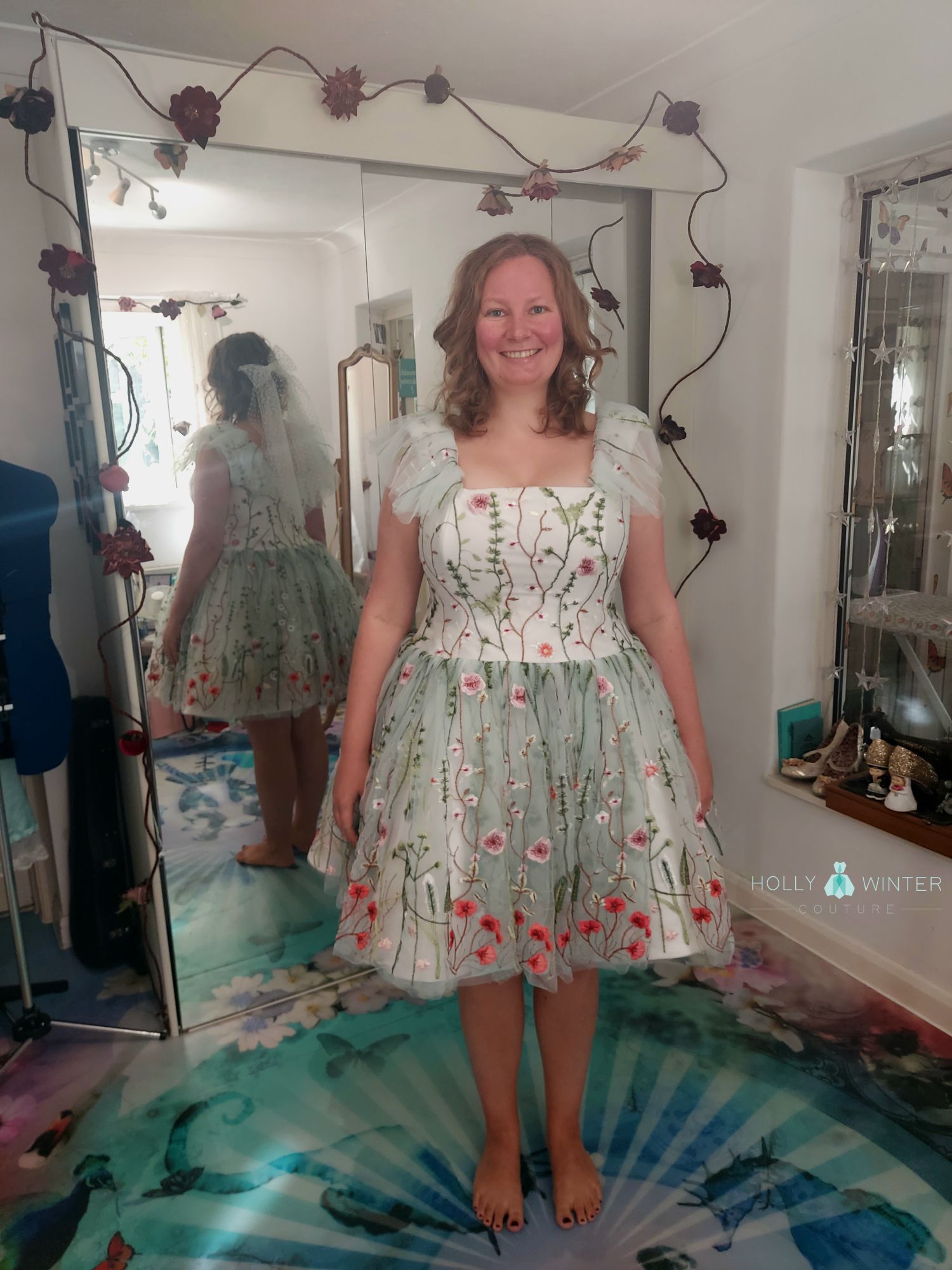
Ice-cream shades of pink and mint green, overlaid with bright floral embroidery……and some in-jokes, cute personal references and favourite characters.The bride’s late mum’s handwriting embroidered in blue on the ribbon wrapping her bouquetTribute tattoo embroidered on a veilTurn it greenTurn it pink, blush, peach and purpleAdd textureAdd volumeMake it the longest veil I’ve ever createdMake it change colour in daylightMake it CinderellaMake it Star Wars, Lord of the Rings and ZeldaMatching – but not too closely matching – jacket embroideryPumpkins and flowersPastel embroidery to repair the bride’s mother’s original veil
And there are more, but as the weddings have yet to take place, I can’t reveal all yet. But here’s a clue about one of them:
How did THIS become a time of sheer joy, in which I was willing the tyre guy to take his time rescuing me?
The hard shoulder of the M25 with a flat tyre is not the best start to a Saturday evening, especially when the RAC guy discovers the spare wheel you’ve had stashed in the boot for eight years doesn’t even belong to – or therefore fit – your car.
I’d had a brilliant day, the first of three on a tea-charged corsetry course (www.moodycorsetry.co.uk), and had foregone having a wee before I left because I figured I could last the 50 minute drive home, even after several cups of tea throughout the afternoon.
Ten minutes in, a lot of smoke from my front nearside wheel announced I should have gone when I’d had the chance. When the RAC’s ETA was two hours, I hopped a fence, scrambled up a bank and found some trees where I could cop a squat in the rain and have a good think about my choices.
A 90 minute wait for the RAC bled into a short 45mph limp on a neon orange loaned wheel and a further hour’s wait for the emergency tyre man at Cobham Services. Blue and shivering from the cold, I parked as far as I could from the backfiring, revving engines of a boy racer meet and tried to find consolation in an overpriced chai latte.
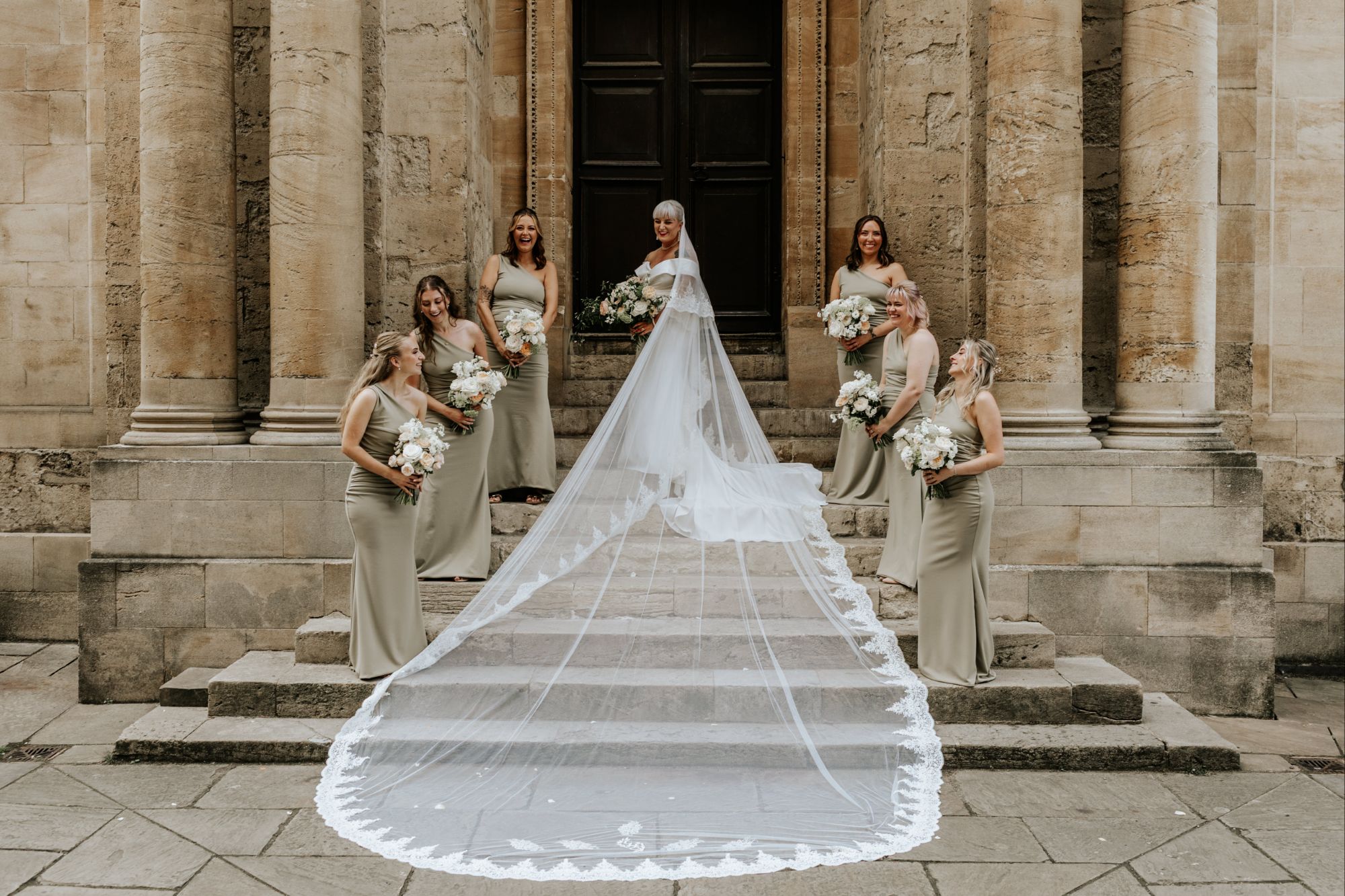
But then the cavalry arrived. Not the tyre man, but my beautiful bride Charlotte dropped her full wedding album. And oh my goodness, I could have sat shivering in the middle of that boy racer meet all night. Because LOOK.
I hope you enjoy these pics as much as I did, wherever you are to see them.
Couple: Charlotte & Sam (@worldof_char and @sarnuel) 26/07/25 The longest veil I’ve ever made, at five metres (just under 200″), with bespoke embroidery and trimmed with exquisite appliquèd lace.
Considering a wedding dress with off-shoulder, Bardot straps? Read this first.
You know I’m not one for following trends for the sake of it, but an unavoidable one this summer is the Bardot neckline. Popularised by the eponymous actress Bridget Bardot in the 1950s and ’60s, the straight (or sweetheart) neckline elongated by off-shoulder straps has actually been around since Regency and Victorian eras.
It’s the straps we need to talk about. Loved for balancing out wide hips, narrowing broad shoulders, showing off the décolleté while remaining elegant and concealing bingo wings, they do have an inherent drawback.
The crux of Bardot straps is this: there will always be a trade-off between how well they fit and how much you can still move your arms.
Gorgeous Sarah opted to remove her Bardot straps (and train) completely, and straighten the neckline.
There are workarounds but all of them involve a compromise of some sort. If you want to be able to lift your arms at all on your wedding day – to hug guests, slow-dance with your new spouse, pick up children, toss your bouquet (or hold it victoriously aloft), throw shapes on the dancefloor, remove your veil or fix your hair – and have your heart set on this classic neckline, here’s what we can do.
Awesome Sophie in her Bardot-neckline wedding dress. Yes, she’s on the loo; yes, she’s allowed me to share this.
Option 1: Do nothing
Accept the fit of the straps as they are, which might be slightly baggy but almost certainly will limit how high you can lift your arms.
Option 2: Tighten them to fit
Some people are happy to sacrifice movement and just want them to sit as straight and snugly as possible. This is fine if it works for you, but your arms will be pinned to your sides and only usable from elbows down.
Option 3: Make them detachable
There are a few ways we can do this, including adding poppers so you can remove them entirely. Alternatively, we can have them fitting snugly but fashion a way for them to fold neatly under your arms if you choose to wriggle your arms out of them completely. Alternatively, you could wear a Bardot style as a bolero or even just a separate ‘collar’ that slips over your shoulders.
Option 4: Add elastic
A popular option with my customers this year has been to run some elastic through (or under) the straps so they fit more snugly but can still extend when arms are lifted. This option will cause some gathering/ruching in the straps, which some have embraced for its frilly effect and had me add elastic to the full strap, while others weren’t keen on the aesthetic and just had me add it towards the back.
Option 5: Engineer an internal runner
This is a clever option if you don’t mind the straps finishing tucked into the back (and/or front) of your dress rather than resting on top. Each strap is looped over a horizontal ‘bar’ of ribbon inside the dress that it can run along, while a length of elastic pulls it back into place when your arms are down. It doesn’t work with all dress and strap styles but worth asking about as it’s the best option for keeping a close fit while allowing maximum movement if it works.
Option 6: Raise where they sit
If you’re open to a neckline that isn’t quite strictly a Bardot, a final option is to raise where the straps sit, so they’re on the edge of your shoulder rather than around your arms. This means losing arm coverage (in case that’s a dealbreaker) and gaining coverage on your back so bear in mind whether you want that or not too.
Beautiful Debs, whose Bardot straps I raised to sit higher on her shoulders so her back would feel less exposed. Her sweetheart neckline lent itself particularly well to this alteration. Raising them also meant that, despite shortening them, she had more freedom of arm movement.
If you’ve yet to start wedding dress shopping, please don’t rule out a Bardot neckline, but remember that it will always require a compromise of some sort. And if you already have your Bardot-neckline dress, please don’t panic. Feel free to drop me a line and we can find the best solution for you and your dress.
Char in her gorgeous Bardot gown (with the five-metre custom veil I made her). Photo: Lauren Brumby Photography
“Can I ask if any brides are planning on changing into a 2nd veil for the evening? I’m not sure my cathedral veil will be practical for all day,” I read in a wedding group on social media this morning.
While some newlyweds stay in their wedding finery throughout the day and into the evening reception, it’s not uncommon to see a change in outfits. It might be the same outfit slightly modified – the train of the wedding dress gets bustled to make the back the same length as the front for dancefloor practicalities, a suit jacket or lace bolero discarded in the heat, detachable sleeves or overskirt whipped off for a transformation.
The transforming wedding dress I created for Gill, featuring a detachable cape veil and overskirt
Some people change their dress entirely. In Japan where I once spent a year, couples go through so many outfit changes on their wedding day – around five – that they start the morning with a feast because they won’t have time to eat again until the end of the night.
Other people change into a different dress or alternative outfit for the evening. It might be for practical reasons, or simply aesthetics.
Left: The dress I made for Rachael for her ceremony; R: Her sparkling evening reception dress
But what about the veil? In the last year, I’ve seen my first requests for veils specifically for the evening reception. Just like dresses, some are transforming and some are shorter versions of the ceremony veil.
Two transforming veils I’ve made for customers, that use a mechanism similar to dress bustles to make them shorter
I’ve also had orders for a shorter version of the ceremony veil so they can still wear a veil for evening without the worry of it being trampled once the dancefloor throng is in full swing. I’m currently making two versions of the same veil for a customer – one 144″ long for the ceremony and the other 30″ for the evening. I’ll share both as soon as I’m allowed.
“It’S nOt TrAdItOnAl!”
I’ve seen some backlash though, from cries of “I’ve seen it all now,” to seamstress refusals on principle to add a bustle to a veil. My favourite scoff as ever is, “It’s not traditional.”
So let’s not forget why we have wedding veils in the first place. In western culture at least, they were intended for the very practical purpose of concealing the bride from evil spirits lurking around churchyards hunting for virgins and, as we know, all brides are virgins. This was once a very real fear.
Over time, the superstition may have faded to near obscurity but the association of the veil with the wedding day has passed firmly into aesthetic tradition. Anyone not subscribing to the fears of old and/or chooses not to wear a blusher tier over their face is already wearing a veil for aesthetics only and not tradition in the strictest sense.
The only reason I didn’t keep my own veil on all day and night nearly 17 years ago was that it was my ‘something borrowed’ and I wanted to give it back before it fell in my dinner/down a toilet. I replaced it with a tulle wrap in the evening. It simply didn’t occur to me to wear a different veil that could take a little gravy (or worse).
So let’s agree that a veil is a headpiece like any other bow, hat, sparkly accessory or whatever. No-one would bat an eyelid at someone changing in or out of one between their own wedding ceremony and reception so I am absolutely here for the evening veil.
Thank you for all the love for these two dresses I revealed this week. But did anyone spot that they’re exactly the same dress, just in different fabrics?
Same same, but different.
The magic of fabric
It’s not just about the colours; texture is everything. Rachael’s dreamy wedding dress was made in drapey, cationic chiffon, which has the contradictory superpowers of being both lightweight and floaty but still falling heavily under its own weight, giving a straight, sleek silhouette (when you keep still!).
The floral confection modelled by Chenai at Rock n Roll Bride Live used printed organza, which is stiffer and bouncier.
OK, I tell a very small lie in that (technical details) the floral dress’s skirt section is cut as a full circle with a horsehair braid hem and Rachael’s chiffon is a double circle. But the number of layers, cut of sleeves, pleating and everything else is the same.
When I create bespoke wedding dresses, I offer a LOT of fabric options. We can pore over stacks of sample books, order in any fabrics I don’t already have and see how each one feels, moves and works with others.
Stroking all the pretties
I am always available for drinking tea and stroking pretty fabrics so please give me a shout if you’d like to come over for a play.
Today The One Ring came full circle for me and I am so excited I just needed to make a note of it.
I’m currently working on the design for a custom veil with elements inspired by The Lord of The Rings. This is awesome enough I itself.
Here’s one I made earlier (in Italian)
Then this morning, I finally got to meet my very good friend’s mother-in-law who only bloody worked with JRR Tolkien himself! Ann worked with “Professor Tolkien” as she referred to him during his time at Oxford, and she told me he was lovely and, “Just like one of his characters.”
I asked which one and she said, “Tom Bombadil.”
I need to visit her again if she’ll have me to pester her in more depth.
What I’m really thinking when I say brides,bridalwear etc
My blog post that’s currently blowing up (for me; everything’s relative) about making wedding dresses for people of all genders and sexes included this side note about the term ‘bridalwear’:
I use the term bridalwear as loosely as possible because not all of my customers identify as brides. I try to use more inclusive terms where I can. I specialise in dresses and the traditionally more feminine styles of weddingwear such as dresses, veils, jumpsuits and separates rather than men’s suiting and tailoring and I’m still answerable to the SEO gods – I need people to find me! As language, attitudes and social mores evolve, this will change of course. In the meantime, I’m always happy to learn and stand corrected if I’m saying or doing something deplorable.
I want to elaborate. I almost always do.
It’s a topic very close to my heart, my family and my English Language degree.
I can’t do away with the term. At least not yet.
Many of my customers not only identify as a bride but embrace the (hopefully) once in a lifetime opportunity to be The Bride. I don’t want to deny them that.
When I know someone is happy to be called a bride, I will use the term for that individual in my conversations with them and in describing them publicly.
Others don’t. I equally don’t want to force an erroneous identity on them or make them feel excluded or othered. I always endeavour to check. Some prefer marrier, partner, or something else.
When I’m talking generally about unknown individuals, I use inclusive, gender-neutral language such as couples, spouse, nearly-weds or customers.
I completed an LBGTQ Awareness Course four years ago with the sadly now defunct Wedding Business School a few years back.
I’d hoped to revisit it for this post but will have to rely on my memory. Quite rightly, it advocated gender-neutral terms.
But I’m finding it tricky to describe what I do, and who I do it for, without saying bridal or bridalwear.
I could – and do – say I make wedding dresses, but I don’t just make those; I make veils, jumpsuits, playsuits and separates including trousers, skirts, capes and overskirts too. My very first foray into creating wedding outfits was inspired by the bow-ties and masculine tailoring of Marlene Dietrich in the film Morocco.
Credits below*
And I love throwing androgynous flamboyance into the mix, like I did when I created the Skye shirt-cape:
But if I say I make wedding outfits or weddingwear, that feels like it covers more than I actually do, because I don’t make traditional menswear like tailcoats, shirts, waistcoats and morning suits.
So I don’t want to waste anyone’s time by contacting me about making them something I don’t make.
And I do want to stay visible in search results when people look for “bridalwear near me”. Don’t even get me started on hashtags. I have to use the hashtags that people looking for the kind of things I make use so they can find me.
How about emojis? Decorative, convenient shorthand, especially where there are character limits. When there are gender neutral options, I use those. If I can use female, male and non-binary together, so much the better.
My Instagram highlight of real customers
For example, on my Instagram, I have a highlight featuring my customers in my creations on their wedding days. Originally I called it Real Brides, which was the maximum character limit that would stay visible on my profile. When I realised this was not only not inclusive but also inaccurate, I changed it to Real Customers, but only Real Custom remained visible and just looked odd. Similarly, Real Weddings became Real Weddin.
Emojis to the rescue. Then I had to pick which skin colours to include (and exclude). ARGH!
Ultimately, I have carved a career out of celebrating individuality. That’s what bespoke is.
So whoever you are and however you identify, please know that I see you, I love you and I’m just waiting for the language and SEO gods to catch up.
*Venue: @weddings_the_boat_shed_salt Photography: @photosbypaloma Bridalwear: me! @hollywintercouture Model: @gabbywaite97 Flowers: @lilybee822 Jeweller: @bishboshbecca Headpieces: @peacock_and_pearl Shoes: @irregularchoice Hair and make-up: @tonisearlemua Cakes: @annalewiscakes Mobile bar: @effervescerefreshments
Perhaps we should be rivals, but we don’t see it that way. There’s plenty of work to go around and we need to know who we can recommend when we’re fully booked. And you can’t work in weddings and not have at least one back-up plan if something takes you out of action in peak season; last year for example, just as I recovered from Covid, I broke my arm. The year before, I’d picked up brides when a dressmaker friend broke her leg.
We have Facebook groups, WhatsApp groups and Christmas parties. We celebrate each other’s new shop openings, dress designs, birthdays and business anniversaries.
More tellingly, we are open and vulnerable with each other. We ask for advice and help. We admit when we don’t know the technique for something or have never used a particular machine or stitch.
Even better, within minutes usually, someone provides the answer and willingly, voluntarily, steps in to teach what we need to know.
Last month, I wanted to know how to do a delicate edging stitch I’d seen at the V&A’s Chanel exhibition. Unfortunately in that case, it turned out I would need two new machines: a picot hemming machine and a time machine, because picot hemming machines haven’t been manufactured for a century, BUT it was dressmakers in my network who told me this.
Anyway. I’m going to go against the sisterhood grain here and call someone out, albeit not by name.
I’d made a veil a bride not local to me who was having her dress altered by someone else. I’d made her friend’s wedding dress a few years back and included a bustle hook as standard, and she asked her seamstress to add one to her dress. She even described quite specifically the type she wanted (there are several).
When she went to pick her dress up, there was no bustle hook. Instead, the seamstress handed her these three safety pins.
This is not a bustle hook. “Just use these,” my bride was told.
There are bustle pins you can buy, but I’ve never recommended them. Figuring out which bits of many layers to attach them to, usually at the point of the wedding when most people have had a few sherberts, is not simple. Worse, they make holes in the fabric, and my bride asked whether this would happen.
“Yes,” was the response, “but hopefully no-one will see them.”
Pick. My. Jaw. Off. The. Floor.
I want to give the seamstress the benefit of the doubt. We all have off days. Maybe she forgot. Maybe she was rushed. Maybe she didn’t actually know how to bustle this dress but she’a a professional seamstress workong with a bridal boutique. Maybe there was a reason she couldn’t do it that hasn’t occurred to me, because I can’t fathom why she recommended this.
I’m not local or available in time so couldn’t do it myself but, predictably, someone from my needle ninja network stepped in within hours to add the bustle hook (thank you again, Tina).
A member of our Facebook group said of she found out the safety pin seamstress was a member, she’d be kicked out.
Another customer, a tattoo artist, was in awe when I told her about how supportive dressmakers are, and was rightly envious. She told me that her industry was rife with rivalry and bitchiness.
We are so passionate about what we do and seeing it done well. Keep your safety pins for emergencies, not your bustles.
My black and white balls-up, and the loveliest person in Germany
CONFESSION: last month, in a first-time, heart-stopping balls-up of my own creation, I made and sent a glittering black moon phase veil to a customer in Germany who’d ordered a glittering ivory one. I know. I KNOW.
New Moon: the ivory veil I should have made and sent in the first place. Shop here if I haven’t put you off.
And she had to pay a massive customs charge – €80 on a £206 veil – because fuck you, Brexit.
It’s all sorted now, she received her ivory veil yesterday and got her customs refund on the original veil (and I’ve covered all her postage costs), and we’ve chatted quite a bit throughout the process.
The original black veil arrived back with me yesterday too, with this beautiful message from the bride.
“And even if there was that small mistake – we made the best of it!” – the card I received with the returned black veil.
And this morning, she left me a five-star review.
The review left today by the loveliest person in Germany.
She has been so patient, lovely, funny and kind throughout that I’m almost tempted to fuck up more often. Almost.
It’s official: the “un-bride” is in. This is ironic as it essentially means that not following trends is the trend.
The stylist soothsayers are stirring their big-data cauldrons this week and forecasting the wedding trends for 2024. Amid the peach fuzz and torn up seating plans, I was pleasantly surprised that for the second year, the crux according to my bellwether Vogue is that formality and traditions will take a backseat to individual style.
So you can keep your big data, front-row seats at Wedding Fashion Week and your cauldrons (but I wouldn’t look a gift horse in the mouth) because I get to see what that actually means in practice. My customers tend to come to me when they have a good idea what they want but can’t find it in the shops – because it’s not something that would take off in the mainstream because not enough people would buy it.
And that’s the awesome thing.
So, based on what people have been asking me for over the last year, here’s what un-briding is looking like. The un-trends.
Transforming dress: see Gill’s detachable train and detachable cape. I’ve also been asked for a voluminous plain dress that unzips at the moment of the first dance
Not a dress. Jumpsuits, playsuits, trousers, separates, shirts with trains. Mixing up the traditionally masculine and feminine, like Skye’s Shakespearean Shirt of Dreams.
Lace that isn’t floral. Have embroidery software, will create lace. I’ve created bespoke lace and embroidery made of moons, text, pets, in-jokes, bats carrying antique micrometers and the handwriting of lost loved ones. I can even do photos if you fancy having your bodice made from other half’s embroidered face (or why stop there? Let’s make the skirt out of all the faces of your in-laws). The next dress I’m making has some of my most ambitious lace I’ve ever made and I am SO excited to show it (and slightly scared about potential legal action).
Colour. I made more black, blush (hello, peach fuzz!) red and blue veils last year than ivory while my bespoke ivory wedding dresses were level pegging with other colours.
Upcycling. I’ve just finished restyling a wedding dress as a cocktail dress (I’ll share pics as soon as it’s had it’s big reveal by the bride) and have incorporated lace from mothers’ and grandmothers’ wedding dresses and veils into others. Save the planet, share the love.